Beyond the Logo: How Employee Uniforms Become an Extension of Your Brand
A well-designed corporate uniform does more than identify employees. It turns brand colors, design, consistency, and employee presentation into a physical part of the customer experience. This guide explains how businesses can make uniforms an authentic extension of their brand without sacrificing comfort or practicality.

Think about the last time you interacted with a company without visiting its website.
Maybe a delivery executive arrived at your door.
Maybe a technician came to your home.
Maybe you walked into a hotel and spoke to someone at the reception.
Maybe you visited a showroom and someone in a neatly branded shirt approached you.
Before that person said a word, you had already noticed something.
What they were wearing.
You probably didn't consciously think:
"Interesting. Their uniform uses a particular shade of blue, their logo is positioned on the left chest, and their shirt has a semi-formal cut."
We don't normally analyze it like that.
We simply form an impression.
Professional.
Casual.
Organized.
Reliable.
Premium.
Careless.
Modern.
Traditional.
Sometimes that impression is fair. Sometimes it isn't.
But it happens.
And that is precisely why corporate uniforms are much more than pieces of clothing with a logo stitched onto them.
They are a physical expression of the brand.
Your Brand Doesn't Stop at Your Website

Businesses spend enormous amounts of time thinking about their visual identity.
The logo is refined.
The website gets redesigned.
The visiting cards are printed.
The social media templates are standardized.
The office signage is carefully planned.
Even the color of a presentation button can become a discussion.
And then someone eventually says:
"Okay, what should the staff wear?"
That decision is often treated as procurement rather than branding.
Pick a shirt.
Pick a color.
Put the logo on it.
Done.
But the employee standing in front of your customer is one of the most visible representations of the company.
That means the uniform deserves the same level of thought as other brand touchpoints.
This is becoming increasingly relevant in India as companies use uniforms beyond traditional industrial environments and in customer-facing roles where employees are visible representatives of the organization.
A Logo Alone Doesn't Make a Uniform Branded
This is probably the first thing worth clearing up.
Take two companies.
Both use a white polo shirt.
Both place their logo on the chest.
Both technically have a "branded uniform."
But one looks distinctly like the company.
The other looks like a generic polo purchased in bulk.
Why?
Because branding is not just the logo.
It is the combination of several small decisions:
Color
Garment style
Fit
Logo placement
Logo size
Embroidery or printing
Fabric appearance
Buttons and trims
Accessories
Trousers or lower-body coordination
Seasonal variations
Consistency across departments
The logo tells people who you are.
The rest of the uniform helps communicate what you are like.
That is why modern corporate uniform design increasingly starts with the brand identity itself and translates it into practical design rules rather than simply adding a logo at the end.
What Does Your Uniform Say About You?
Imagine three employees arriving at a customer's office.
Employee A
A crisp formal shirt, subtle logo, coordinated trousers, and clean finishing.
The impression?
Probably structured and professional.
Employee B
A brightly colored polo, relaxed fit, and larger branding.
The impression?
Perhaps energetic, approachable, and informal.
Employee C
A faded shirt, oversized logo, and inconsistent sizing.
The impression?
The company may not pay much attention to detail.
None of these conclusions necessarily tells you anything about the actual quality of the companies.
But that is the point.
Customers don't get to see your internal processes before forming an impression.
They see what is in front of them.
And sometimes, that means they see your uniform before they experience your service.
Corporate Uniforms Are Repeated Brand Touchpoints
A billboard is seen for a few seconds.
An advertisement may appear in someone's feed once.
A website visitor may leave after two minutes.
A uniform is different.
An employee may wear it for eight hours.
Five days a week.
For months.
That employee may interact with dozens of customers, vendors, partners, and members of the public during that period.
This makes the uniform a remarkably persistent brand touchpoint.
Think about a technician visiting ten homes in a day.
Or a restaurant team serving hundreds of customers.
Or a hotel employee interacting with guests throughout a shift.
Or a delivery executive travelling across a city.
The company's visual identity is moving around with the employee.
And unlike an advertisement, the person wearing the uniform is also doing something.
They are answering a question.
Delivering something.
Solving a problem.
Welcoming a customer.
Handling a complaint.
Installing equipment.
Serving food.
The uniform becomes attached to the experience.
The Interesting Part: Branding Has to Work for Employees Too
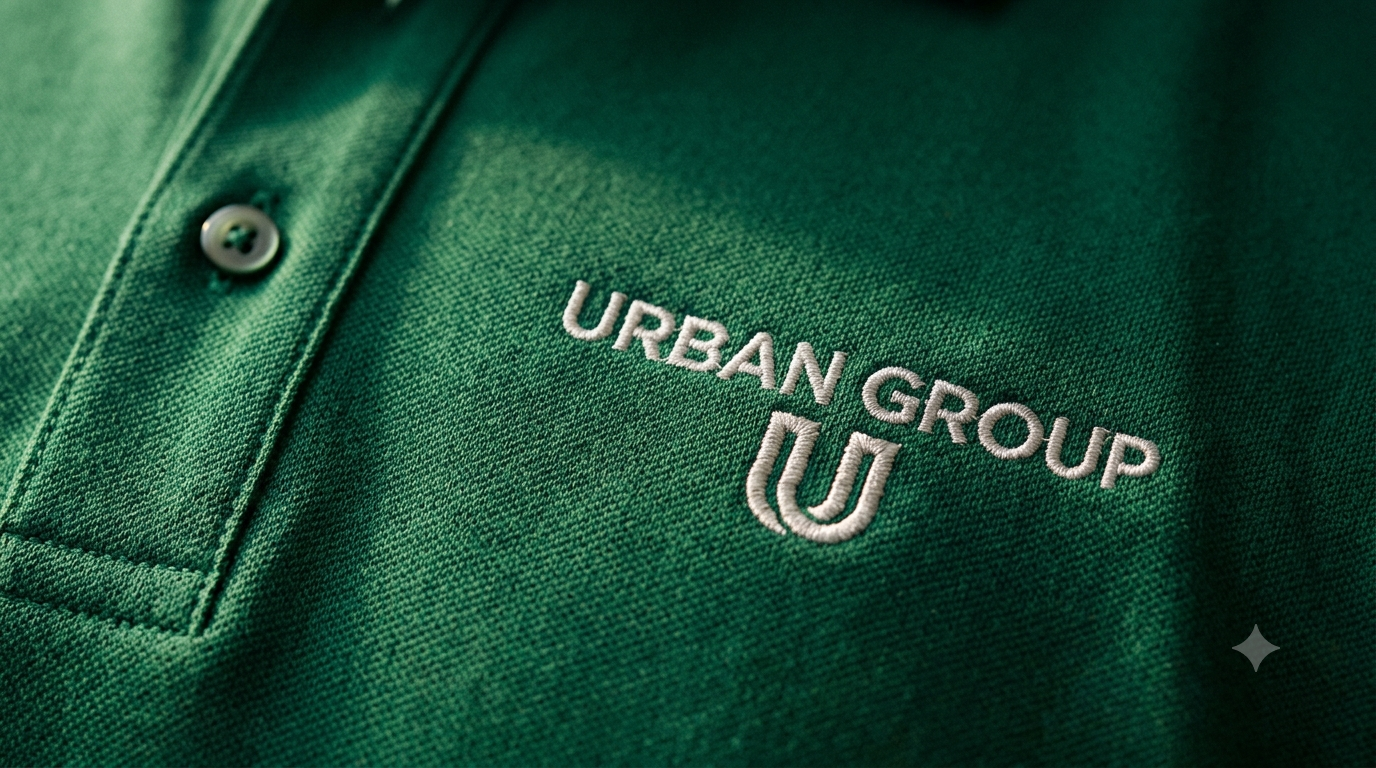
There is a mistake businesses can make here.
They can become so focused on how the uniform looks to customers that they forget who actually has to wear it.
Imagine designing a beautiful uniform that looks fantastic in photographs.
Then imagine giving it to an employee who has to wear it for nine hours in the middle of an Indian summer.
Suddenly, the branding exercise has a problem.
If the employee hates wearing the uniform, the brand suffers too.
They may keep adjusting the collar.
Roll up the sleeves.
Leave the shirt untucked.
Wear an unofficial jacket over it.
Or simply look uncomfortable.
The carefully designed brand experience has now become a daily negotiation.
This is why comfort is not separate from branding.
It is part of branding.
A uniform that employees are comfortable wearing has a much better chance of being worn properly and consistently. Recent industry guidance similarly emphasizes balancing brand identity with employee comfort and everyday practicality.
The Best Uniforms Don't Shout
There is a temptation when branding uniforms to make the logo bigger.
If the logo is good, surely a bigger logo is better?
Not necessarily.
A uniform can become less professional when branding becomes excessive.
The goal isn't to turn an employee into a walking billboard covered from shoulder to shoulder in company graphics.
The goal is recognition.
There is a difference.
A well-designed uniform might use:
A subtle embroidered logo
Consistent brand colors
A distinctive collar
A particular shirt or polo style
A coordinated trouser or skirt
A branded jacket for another season
A small sleeve detail
A consistent accessory
The employee doesn't need to look like an advertisement.
They need to look unmistakably like part of the organization.
Color Does More Work Than Most People Realize
Color is one of the easiest ways to connect a uniform to an existing brand.
But matching the exact color of a logo isn't always enough.
Suppose a company's brand color is a strong red.
Does that mean the entire shirt should be red?
Not necessarily.
The answer depends on:
Industry
Work environment
Customer expectations
Garment type
Lighting
Fabric
Frequency of use
Desired brand personality
A financial services company may want restrained colors.
A children's education brand may choose something more expressive.
A luxury hotel may prefer understated tones.
A logistics company may prioritize visibility and practicality.
The same color can also look dramatically different depending on fabric and lighting.
So the question shouldn't simply be:
"What is our brand color?"
It should be:
"How should our brand color behave on clothing?"
That's a much better design question.
Consistency Is Where Branding Becomes Powerful
One employee wearing a branded shirt is useful.
Fifty employees wearing inconsistent versions of that shirt is less useful.
Imagine one branch using navy shirts.
Another using a slightly different blue.
One team wearing embroidered logos.
Another using printed logos.
One location using formal trousers.
Another is using jeans.
Nobody has necessarily done anything terrible.
But the brand begins to look fragmented.
This becomes particularly important when businesses expand.
One office becomes three.
Three locations become ten.
The team grows.
New employees join.
Uniforms are reordered.
People leave.
New suppliers become involved.
Without a clear uniform specification, the design slowly changes.
A sleeve becomes slightly different.
The logo moves.
The color changes.
The fabric changes.
And after a few years, the company technically has uniforms—but no longer has one uniform identity.
A simple uniform style guide can help define colors, logo placement, fabrics, fits, and seasonal variations so future orders remain consistent as the organization grows.
Your Uniform Should Evolve With Your Brand
Consistency doesn't mean never changing.
Brands evolve.
A company that looked traditional ten years ago may now want to appear younger and more contemporary.
A startup may grow into a large organization.
A business may expand from one service into several.
The uniform should be capable of evolving with that change.
The important thing is to avoid changing everything at once without a reason.
Sometimes a small adjustment is enough:
Updating the cut
Refining the colors
Simplifying the logo
Introducing a better fabric
Creating seasonal versions
Updating accessories
The objective isn't to make employees look fashionable every year.
It is to ensure that the uniform remains relevant to the business and practical for the people wearing it.
Different Roles Can Still Belong to One Brand

This is particularly important for larger organizations.
A hotel does not need its chef, receptionist, housekeeping staff, technicians, and security personnel to wear identical garments.
A hospital does not need its doctors, nurses, technicians, and administrative staff to dress exactly the same way.
A manufacturing company does not need its office employees and factory workers to wear identical clothing.
Yet they can still look like one organisation.
How?
Through a shared visual language.
Perhaps the same colour palette.
Perhaps consistent logo placement.
Perhaps complementary garments.
Perhaps similar design details.
Perhaps the same embroidery treatment.
The clothing changes according to the role.
The brand remains consistent.
This is often much more effective than forcing every employee into the same garment simply because "uniform" means "same clothes."
The Uniform Should Match the Promise of the Brand
Here is a useful exercise.
Forget the uniform for a moment.
Ask:
What does our brand promise?
Reliable?
Premium?
Approachable?
Fast?
Innovative?
Traditional?
Technical?
Friendly?
Precise?
Now ask:
Would our uniform communicate the same thing?
A premium hospitality brand and a rugged industrial contractor should not necessarily dress their teams in the same way.
Both can have excellent uniforms.
They simply need to communicate different things.
The uniform should support the promise rather than contradict it.
Don't Forget the Customer's Practical Experience
There is another reason uniforms matter that has little to do with aesthetics.
Recognition.
Imagine a technician arriving at a customer's home.
The customer doesn't know the technician personally.
How do they immediately know:
"Yes, this is the person from the company I called."
The uniform helps answer that question.
The same applies in:
Hotels
Hospitals
Retail stores
Restaurants
Showrooms
Airports
Schools
Security services
Logistics
Field services
A clear uniform reduces uncertainty.
It tells the customer:
"This person belongs here."
That is a small thing.
But small things matter when they happen thousands of times.
A Simple Test: Remove the Logo
Here's a surprisingly useful test when reviewing a proposed uniform.
Cover the logo.
Now look at the garment.
Can you still tell something about the brand?
Does the colour feel intentional?
Does the silhouette feel right?
Does the combination look distinctive?
Does the overall design feel aligned with the company?
If removing the logo makes the entire brand identity disappear, the uniform may be relying too heavily on the logo.
Good uniform design makes the logo part of the identity.
It doesn't make the logo the entire identity.
Five Questions to Ask Before Designing a Branded Uniform
Before placing a bulk order, ask:
1. What should customers feel when they see our team?
Professional? Approachable? Premium? Reliable? Energetic?
2. What does our employee actually do all day?
The uniform needs to support the work, not just the photograph.
3. How should our existing brand identity translate into clothing?
Look beyond the logo and consider colours, styling and visual language.
4. Can employees comfortably wear this for an entire shift?
If the answer is uncertain, the design isn't finished.
5. Will this still look consistent when we have three times as many employees?
A uniform programme needs to survive growth.
The Real Meaning of a Branded Uniform
A branded uniform isn't successful because someone can see your logo from twenty metres away.
It is successful when several things happen at the same time.
The customer recognises the employee.
The employee feels comfortable and confident.
The garment reflects the company's personality.
Different departments still feel connected.
The uniform remains practical throughout the working day.
And months later, the organisation still looks like the same organisation.
That's when clothing becomes branding.
Not because the logo is bigger.
Not because the uniform is expensive.
But because the design, people and brand are telling the same story.
Final Thought
Your website tells people what your company says about itself.
Your advertisements tell people what you want them to remember.
Your employees show people what the company is actually like.
And what those employees wear becomes part of that experience.
A uniform therefore deserves more thought than:
"Where should we put the logo?"
The better question is:
"If our employees are representing us all day, what should they communicate before they even say hello?"
That is where uniform design becomes interesting.
Because the best uniforms don't merely identify employees.
They make the brand feel present.
Frequently Asked Questions
How do corporate uniforms improve brand identity?
Corporate uniforms create a consistent visual representation of a company whenever employees interact with customers, partners or the public. Colour, garment style, logo placement and consistency can reinforce recognition.
Should a company uniform always match its brand colours?
Not necessarily. Brand colours can be incorporated into uniforms without covering the entire garment in those colours. The choice should consider the industry, environment, garment and desired brand personality.
Is putting a company logo on a shirt enough to create a branded uniform?
No. A truly branded uniform considers the complete visual system, including colour, fit, garment style, logo treatment, accessories and consistency.
Should different departments wear different uniforms?
They can. Different roles often have different functional requirements. A company can maintain a common visual identity while adapting garments to individual departments.
Does employee comfort affect brand perception?
Yes. An uncomfortable uniform can lead to poor fit, inconsistent wearing and visible discomfort. A uniform that employees are comfortable wearing is more likely to be worn consistently and professionally.
How can companies maintain uniform consistency across multiple locations?
A documented uniform specification can define approved fabrics, colours, garment styles, logo placement, branding methods, sizing and other design details. This helps future orders remain consistent.
About Uniformat
At Uniformat, uniforms can be approached as more than standardised employee clothing.
They can become a practical extension of the organisation itself — combining brand identity, employee comfort, functionality and consistency into something people experience every working day.
Because a company's brand shouldn't stop at its logo.
It should be visible in the way the organisation shows up.
Want your team's uniform to look like your brand—not just carry its logo?
Talk to Uniformat about your brand colours, employee roles and uniform requirements.
Request a bulk quoteTags
- #Corporate Uniforms
- #Brand Identity
- #Employee Uniforms
- #Workwear
- #Uniform Branding
- #Corporate Branding
- #Custom Uniforms